50/30/20 Budget Rule: How to Manage Your Monthly Income
Half for what you must pay, 30% for what you choose, 20% for your future. Here's how the rule works on an Indian salary, and what to do when rent makes 50% impossible.

In this article
- What is the 50/30/20 rule?
- Start with take-home pay, not CTC
- The 50%: needs
- The 30%: wants
- The 20%: savings and debt
- Needs or wants? Sorting the grey areas
- 50/30/20 calculator
- 50/30/20 examples by salary
- When your needs are more than 50%
- How to use the rule this month
- Strengths and limits of the 50/30/20 rule
- The bottom line
- FAQs
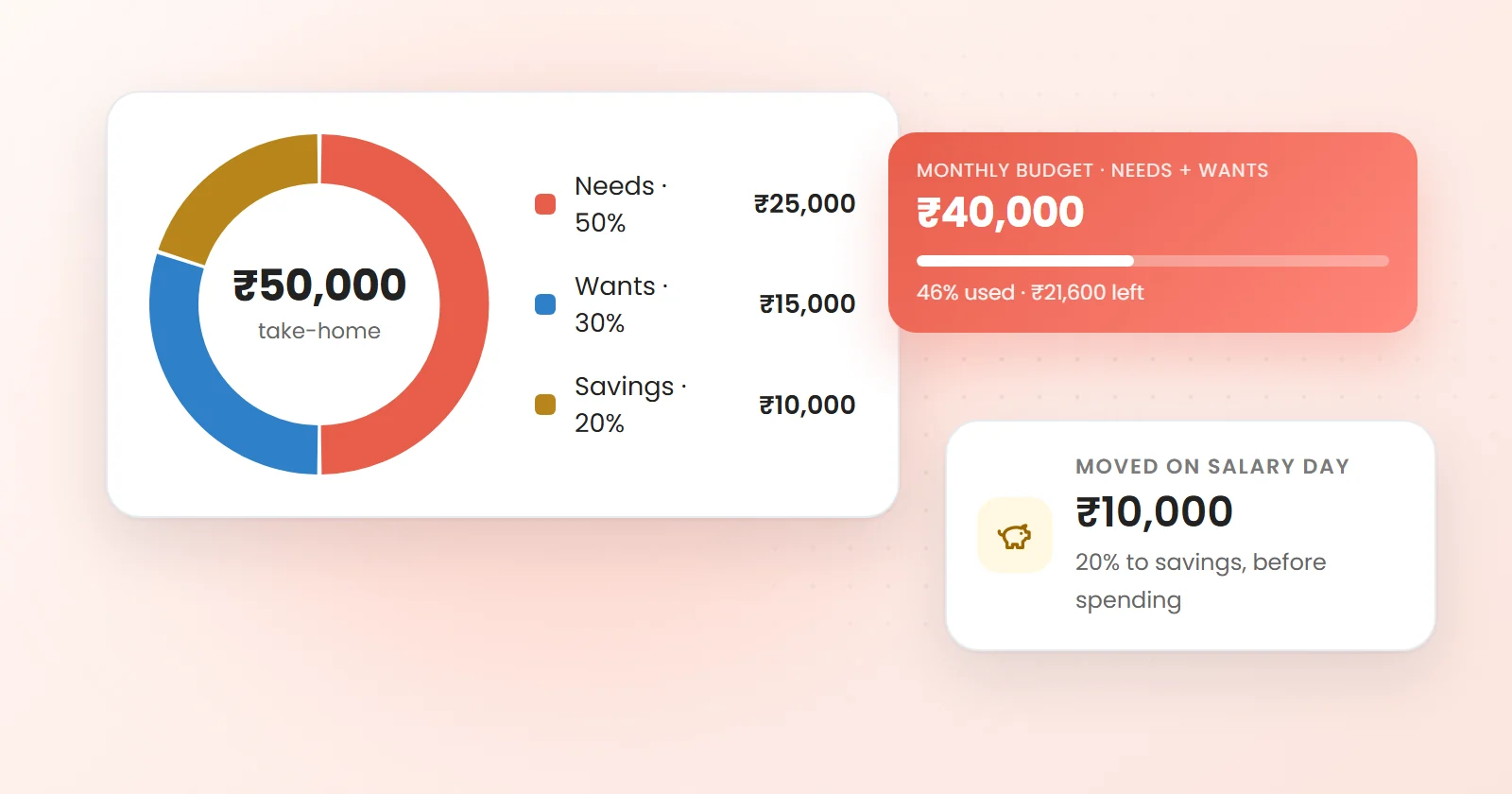
Your salary lands: ₹50,000 after tax and PF. Rent, groceries, a friend's birthday dinner, the SIP you keep meaning to start. Where should it all go?
The 50/30/20 rule gives a starting answer in one line, and it's popular for a reason: you don't need to track forty categories to use it. You only need to know which of three buckets each rupee belongs in.
Split your take-home pay into 50% needs, 30% wants and 20% savings and extra debt repayment. On ₹50,000 that's ₹25,000, ₹15,000 and ₹10,000.
What is the 50/30/20 rule?
It's a simple way to divide your income, popularised by Elizabeth Warren and Amelia Warren Tyagi in their 2005 book All Your Worth. Instead of a detailed budget, you check three proportions:
It isn't a law of personal finance. It's a benchmark that tells you, quickly, whether your spending is roughly in balance.
Start with take-home pay, not CTC
The rule uses the money that actually reaches your account each month. Your CTC includes employer PF, gratuity, variable pay and benefits you never see as cash, and your gross salary is reduced by TDS, employee PF and professional tax before it lands.
So a "₹8 lakh package" is not ₹66,667 a month to budget with. Open your bank app and use the salary credit amount. If your income varies, use the average of your last three months, or your lowest recent month to be safe.
The 50%: needs
Needs are the costs you'd have to keep paying even in a tight month:
- Rent or home loan EMI, society maintenance
- Staple groceries
- Electricity, water, cooking gas, basic internet
- Commute to work
- Health and term insurance premiums (divide annual premiums by 12)
- Minimum payments on loans and credit cards
- School fees, medicines, and support to family where it's a real obligation
The 30%: wants
Wants make life good, and you could pause them next month without real harm: eating out and delivery, OTT subscriptions, shopping beyond basics, weekend plans, holidays, gadget upgrades.
30% for wants surprises people. It's deliberate. A budget with no room for enjoyment gets abandoned, and a budget you abandon saves nothing.
The 20%: savings and debt
This bucket builds your future: an emergency fund first, then goals and long-term investments, and any repayment beyond the minimum on loans or credit cards. Our guide on how much to save every month covers what to prioritise inside the 20%.
Needs or wants? Sorting the grey areas
Most arguments about the rule are really arguments about classification. A useful test: could you stop or downgrade it next month without real harm? If yes, the part above the basic version is a want.
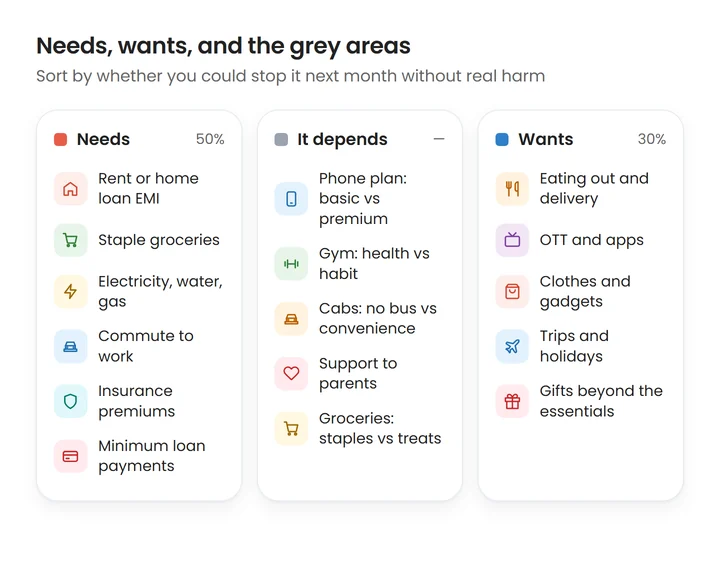
A ₹299 phone plan is a need; the ₹999 plan you picked for the extra data you never use is partly a want. Staple groceries are needs; imported cheese is a want. Be honest rather than generous with yourself, since the split only helps if the labels are true.
50/30/20 calculator
Your 50/30/20 split
Enter your monthly take-home pay: the amount credited after tax, PF and other deductions.
Rounded to the nearest ₹10. A starting point, not a verdict.
50/30/20 examples by salary
| Take-home pay | Needs (50%) | Wants (30%) | Savings (20%) |
|---|---|---|---|
| ₹25,000 | ₹12,500 | ₹7,500 | ₹5,000 |
| ₹40,000 | ₹20,000 | ₹12,000 | ₹8,000 |
| ₹60,000 | ₹30,000 | ₹18,000 | ₹12,000 |
| ₹1,00,000 | ₹50,000 | ₹30,000 | ₹20,000 |
At lower incomes, needs often take more than half, especially in cities. At higher incomes, it's usually easy to keep needs under 50%, and the real risk is wants quietly expanding to fill the space. Many people on a ₹1 lakh take-home can save well beyond 20%.
When your needs are more than 50%
In Bengaluru, Mumbai, Delhi NCR or Pune, rent alone can take a third of a starting salary. Say you take home ₹45,000: rent ₹16,000, groceries ₹5,000, commute ₹3,000, bills ₹2,500 and insurance ₹1,500 add up to ₹28,000, about 62%. The rule says ₹22,500.
That doesn't make the rule useless. It tells you where the pressure is. You have two sensible adjustments:
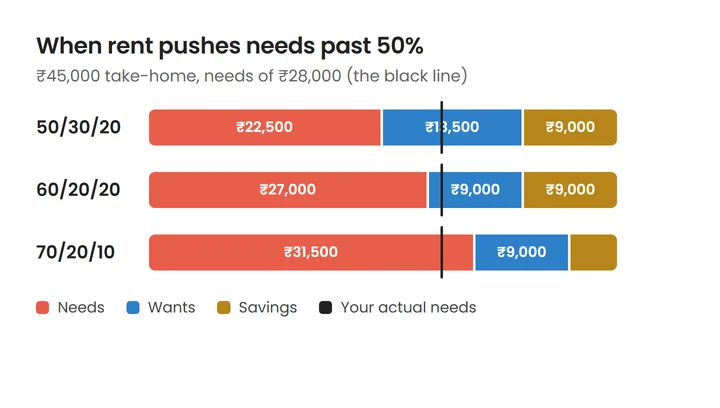
- 60/20/20: needs take more, wants take less, savings stay at 20%. This is usually the right move.
- 70/20/10: a temporary compromise if even 20% for wants feels impossible. Set a date to get back to 20% savings, for example when your lease renews or your next increment arrives.
What to avoid is quietly letting savings drop to zero. Reducing needs is slow (a cheaper flat, a flatmate, a different commute) but it's the only fix that lasts. If you share a flat, make sure rent is split fairly by room rather than equally.
How to use the rule this month
Find your real take-home
Use last month's salary credit, not your offer letter.
Label last month's spending
Go through your bank and UPI history and tag each payment as need, want or savings. Where is my money going? shows a quick way to do this.
Compare with the targets
Work out your actual percentages. Don't fix anything yet; just see which bucket is over.
Automate the 20% on salary day
Move savings out first so the rule survives a busy month.
Give wants a weekly amount
₹15,000 a month is roughly ₹3,500 a week. A weekly number is much easier to keep than a monthly one.
Review at month end
Adjust the split, not your honesty about the labels.
Strengths and limits of the 50/30/20 rule
Why it works
- Takes ten minutes to set up
- Leaves room for enjoyment, so it lasts
- Builds saving into the plan
Where it falls short
- Ignores high metro rents
- Can be too loose on higher incomes
- Doesn't handle irregular or annual bills by itself
If you want more control than three buckets give you, graduate to a category budget. How to create a monthly budget you can actually follow builds one step by step, including festivals and yearly premiums.
The bottom line
The 50/30/20 rule is a benchmark, not a verdict. Use it to see whether needs, wants and savings are in a sensible balance, adjust it honestly for your rent and responsibilities, and protect the savings share above all. If 20% isn't possible this month, start with what is, and move it out on salary day.
Frequently asked questions
Is the 50/30/20 rule realistic in India?
It works well as a benchmark, but in big cities needs often exceed 50% on starting salaries because of rent. A 60/20/20 split, which trims wants and keeps savings at 20%, is a common and sensible adjustment.
Do EMIs count as needs or savings?
Minimum EMI payments count as needs, because you must pay them. Anything you pay above the minimum to clear a loan faster counts towards the 20% savings and debt bucket.
Where does money I send to my parents go?
If it's a genuine obligation that covers their essential costs, treat it as a need. If it's a gift or an optional contribution, it belongs in wants. Many families have a bit of both.
Does the 20% include investments like SIPs?
Yes. The 20% covers everything that builds your future: emergency fund, recurring deposits, investments and extra debt repayment. Which products suit you is a separate decision; this rule only sets how much goes there.
What is the difference between 50/30/20 and a zero-based budget?
50/30/20 sets three broad proportions. A zero-based budget assigns every rupee of income to a specific category until nothing is left unassigned. Zero-based budgets give more control but take more effort; many people start with 50/30/20 and move to a category budget later.