Where Is My Money Going? A Simple Guide to Tracking Your Spending
If your salary disappears and you can't say where, you don't have a spending problem yet. You have a visibility problem, and it takes about half an hour to fix.
In this article
The salary came in on the 1st. It's the 22nd, the balance is ₹4,000, and nothing big happened. No new phone, no trip. So where did it go?
This is one of the most common money frustrations, and the answer is almost never one thing. It's a handful of categories you underestimate and a few payments you can't remember. The good news: you can find out in about 30 minutes, using statements you already have.
- 5 min: gather last month's bank, card and UPI history.
- 10 min: sort every payment into seven buckets.
- 5 min: remove transfers, refunds and card bill payments.
- 5 min: total each bucket as a share of take-home.
- 5 min: circle three surprises and choose one change.
Why it feels like money just disappears
Three things make spending hard to see:
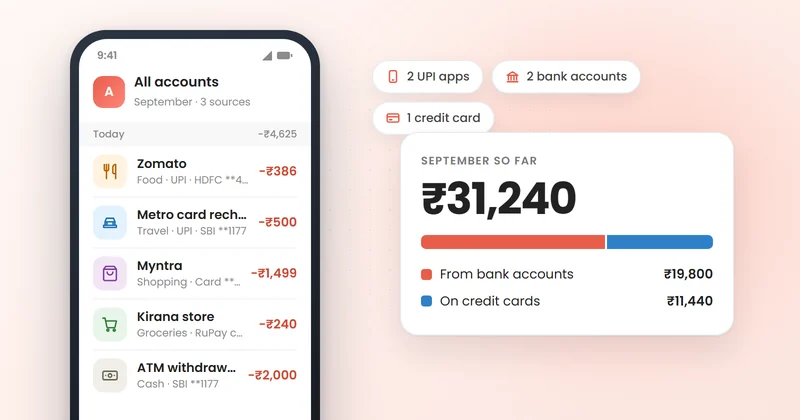
- It's spread out. Two UPI apps, a salary account, a credit card and some cash, and no single place that shows the total.
- Most of it is small. Nobody remembers twelve ₹90 payments, but they're ₹1,080.
- Some of it isn't yours. You paid ₹3,200 for a group dinner; your share was ₹800. The statement shows ₹3,200 either way.
Find out where your money went in 30 minutes
Minutes 0–5: Gather last month
Download or open last month's statements for every account you spend from: savings and salary accounts, each credit card, and the history in each UPI app. Pick a complete calendar month. If you use cash, write down roughly what you spent it on.
Minutes 5–15: Sort into seven buckets
Don't aim for precision. Put each payment into one of these:
- Home and bills: rent, electricity, internet, phone, maintenance, insurance
- Food: groceries, eating out, delivery
- Transport: fuel, metro, cabs and autos
- Shopping: online orders, clothes, household
- Subscriptions: OTT, apps, AutoPay mandates, recharges
- People: UPI transfers to individuals
- Cash and unknown: ATM withdrawals and anything you can't identify
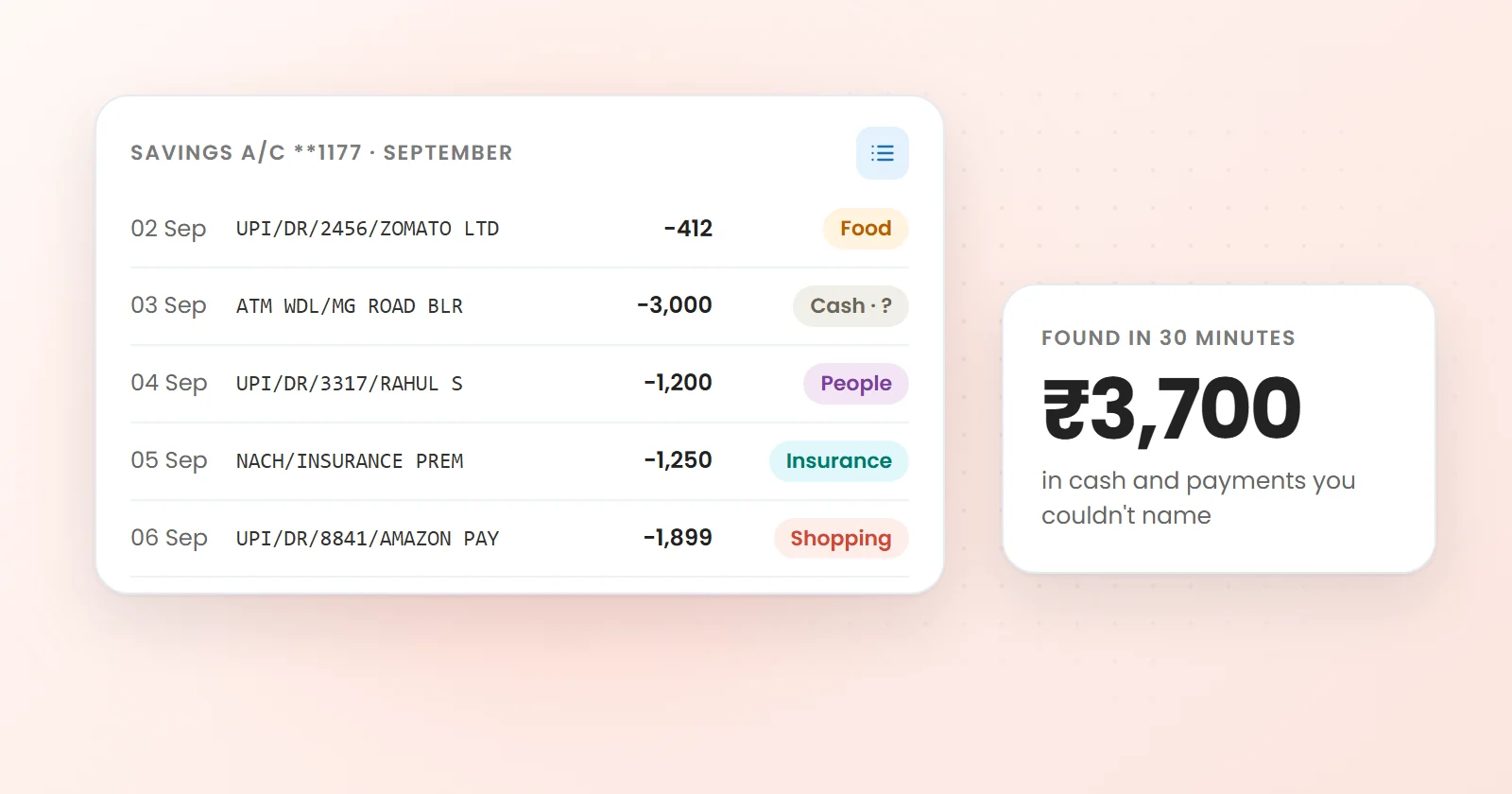
Bank narrations are cryptic. UPI/DR/2456/ZOMATO is food; NACH or ACH is usually an EMI, insurance premium or SIP; ATM WDL is cash.
Minutes 15–20: Remove what isn't spending
- Transfers between your own accounts. Moving money isn't spending it.
- Credit card bill payments. Count the individual card spends instead, or you'll count them twice. Here's why.
- Refunds and reversals, which should cancel out the original purchase.
Minutes 20–25: Total each bucket
Add up each bucket and divide by your take-home pay. Percentages make categories comparable, and they show whether rent and bills are squeezing everything else.
Minutes 25–30: Circle three surprises
Look for the numbers that are bigger than you would have guessed. Pick one to change next month. One change you make beats five you plan.
What a typical result looks like
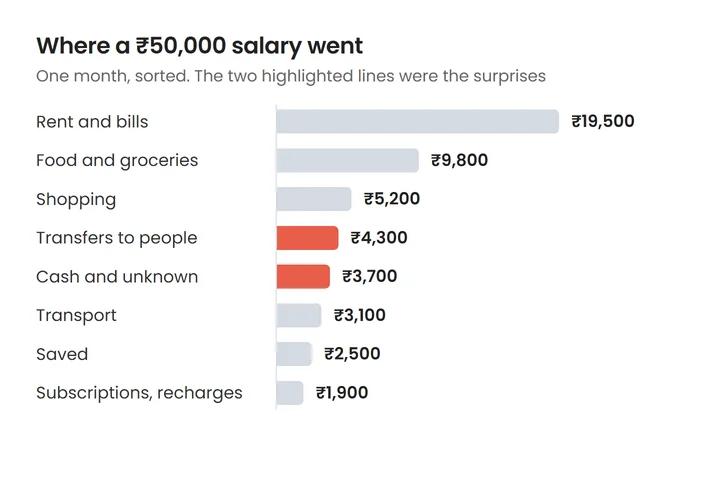
In this example, rent and food were large but expected. The surprises were ₹4,300 in UPI transfers to people and ₹3,700 in cash and payments nobody could name. Together that's 16% of the salary, and it's exactly the part a quick look at the bank balance never reveals.
The usual money leaks
When people do this exercise, the same culprits come up again and again:
| Leak | Why it's invisible | What to do |
|---|---|---|
| Cash withdrawals | ₹2,000 leaves the ATM and no record follows | Note what cash is spent on, the same day |
| UPI transfers to people | Shared bills, family support and loans all look the same | Label each one; track shared expenses separately |
| Subscriptions and mandates | Small, automatic and easy to forget | Audit them; see the UPI AutoPay guide |
| Delivery and convenience fees | Added at checkout, rarely noticed | Compare total cost, not item price |
| Small daily UPI payments | Each is too small to register | Watch the daily total; see daily expense tracking |
| Credit card spends | Hidden inside one big bill payment | Look at the card statement line by line |
Look closer at "transfers to people"
UPI transfers to individuals are one of the most misunderstood lines on a statement. They mix three very different things:
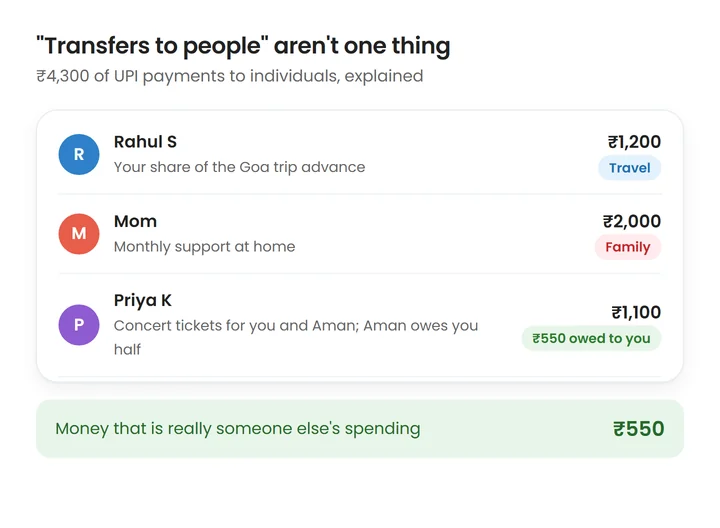
- Your own spending that someone else paid for first, like a trip advance or your share of a dinner.
- Obligations, like support to parents, which belong in your budget as a need.
- Money you're owed, when you paid for others. This isn't your spending at all, as long as it comes back.
If a lot of your money moves through friends and flatmates, expense splitting vs expense tracking explains how to keep both pictures accurate.
Questions to ask your numbers
- Which bucket was furthest from what I would have guessed?
- Which payments would I not make again?
- How much of my spending was decided by other people's plans?
- Is money leaving for things that happened last month, like a card bill or an EMI?
- If I earned ₹5,000 less, which bucket would I cut first? (That's your easiest saving.)
Once you've found the leaks, how to find and cut unnecessary expenses turns them into specific cuts.
Keep the picture without doing this every month
The 30-minute check is a great diagnosis and a poor habit, because nobody wants to sort statements every month. To keep the picture current, track as you go: automatically where you can, and weekly at most. How to track your expenses and stop overspending covers the setup, and managing UPI and card spending covers keeping several accounts in one view.
The bottom line
Your money is going somewhere specific, and last month's statements already know where. Sort one month into a few buckets, strip out transfers and double counts, and look for the lines you can't explain. Then change one thing, and set up tracking so next month answers the question before you have to ask it.
Frequently asked questions
Why does my salary finish before the end of the month?
Usually a combination of high fixed costs, small daily payments that add up, and irregular expenses that weren't planned for. Sorting one month of statements into categories shows which of these applies to you.
How do I see all my UPI payments in one place?
Your bank statement lists UPI payments from every app linked to that account. If you use several bank accounts, check each statement, or use a tracker that records transactions from all your banks' SMS alerts.
What do NACH and ACH mean on a bank statement?
They're automated debits set up with a mandate, typically for loan EMIs, insurance premiums, SIPs or subscriptions. Each one should match something you knowingly signed up for.
How often should I check where my money is going?
Do a full check once to get a baseline, then a quick weekly look at your tracked spending. A detailed review every few months is enough after that.