How to Save Money Every Month: 15 Simple Ways That Actually Work
Saving isn't a heroic budget you abandon by the 12th. It's a handful of small systems, most of them set up once, that stop your salary from quietly draining away.
In this article
Salary lands on the 1st. By the 20th you're checking your balance before ordering a ₹180 chai and samosa. Nothing dramatic happened in between: no big purchase, no emergency. The money just went.
That feeling is common, and it usually isn't a willpower problem. It's a systems problem. Money that stays in your spending account gets spent, and small payments that never feel like spending add up quietly. The fixes below change that, and most of them are set up once rather than fought for every day.
- Save first, not last. Move a fixed amount out on salary day.
- Know your real number. Track one full month before you cut anything.
- Plug recurring leaks. Unused subscriptions, fees and interest are the easiest money you'll find.
- Cap the categories that drift. Food delivery, quick-commerce top-ups and impulse shopping.
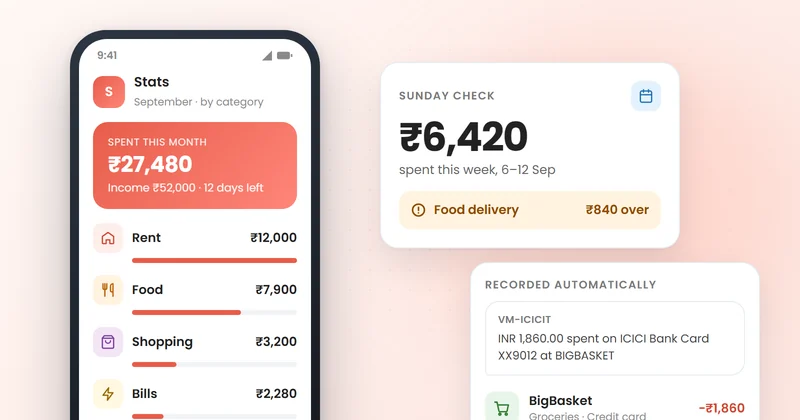
- Review weekly. Ten minutes on a Sunday beats a painful audit at month-end.
Before you cut anything, find out what a month really costs
Most saving plans fail because they're built on a guess. You can't decide what to cut until you know where the money goes, and almost everyone underestimates the small stuff: the ₹60 UPI payments, the ₹149 renewals, the delivery fee that is somehow ₹40 now.
Spend one month simply recording what goes out. Don't judge it and don't change anything yet. If that sounds like a chore, our guide on how to track your expenses covers methods that take a few minutes a week, and where is my money going? walks through reading a bank statement for leaks.
Set up the system: do these once
These five take an evening. After that, they work in the background every month.
1. Pay yourself first on salary day
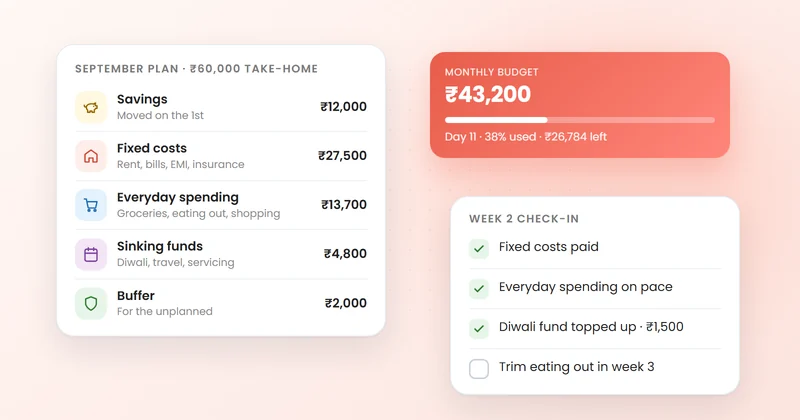
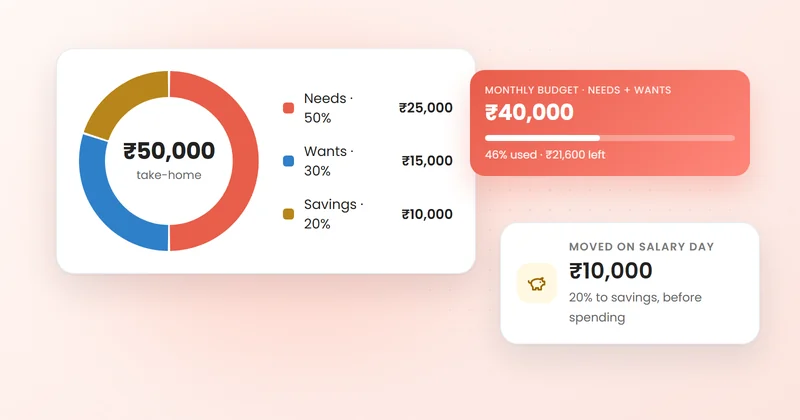
Set up a scheduled transfer for the day your salary arrives, and move your savings out before you spend a rupee. Whatever remains is what you live on.
This flips the usual order. "I'll save what's left" almost always leaves very little, because spending expands to fill whatever balance you can see.
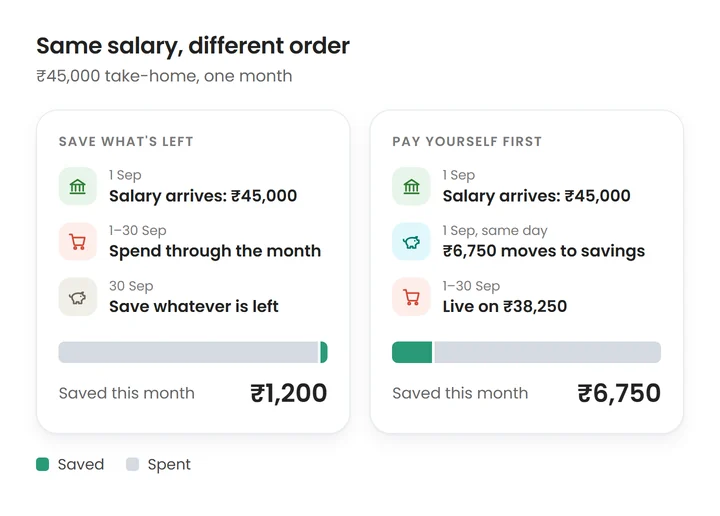
Start with an amount that doesn't hurt, even 5–10%, and raise it later. A transfer you keep making beats an ambitious one you cancel in March. Not sure what the right amount is? See how much you should save every month.
2. Keep savings where your UPI can't reach
If your savings sit in the same account as your UPI apps and debit card, they're one tap away from becoming a sale purchase. Keep them in a separate savings account, or a recurring deposit, that isn't linked to any payment app.
The point isn't to make the money unreachable in an emergency. It's to add just enough friction that spending it becomes a decision rather than a reflex.
3. Build a small buffer before anything ambitious
An unexpected ₹8,000 phone repair shouldn't go on a credit card you can't clear. Before any other goal, build a buffer of at least one month's essential expenses, then grow it towards three to six months. The savings guide explains how to size it for your income.
4. Give your month a spending number
"Spend less" isn't a plan. "₹32,000 this month, all in" is. The quickest way to a number is the 50/30/20 rule; for something tailored to your fixed costs, build a monthly budget you can actually follow.
5. Turn yearly expenses into monthly ones
Annual bills are why a good month is often followed by a broke one. Divide each by 12 and set that amount aside every month, so the bill is already covered when it arrives.
| Yearly expense (example) | Per year | Set aside monthly |
|---|---|---|
| Health insurance premium | ₹18,000 | ₹1,500 |
| Two-wheeler insurance and servicing | ₹7,200 | ₹600 |
| Diwali, weddings and gifts | ₹15,000 | ₹1,250 |
| A ₹27,000 phone, replaced every 3 years | ₹9,000 | ₹750 |
| Total | ₹49,200 | ₹4,100 |
Illustrative amounts. Use your own policy renewal dates and last year's festival spending.
Plug the leaks: usually the easiest money
Leaks are costs that give you little or nothing back. Fixing them doesn't change how you live, which is exactly why they come first.
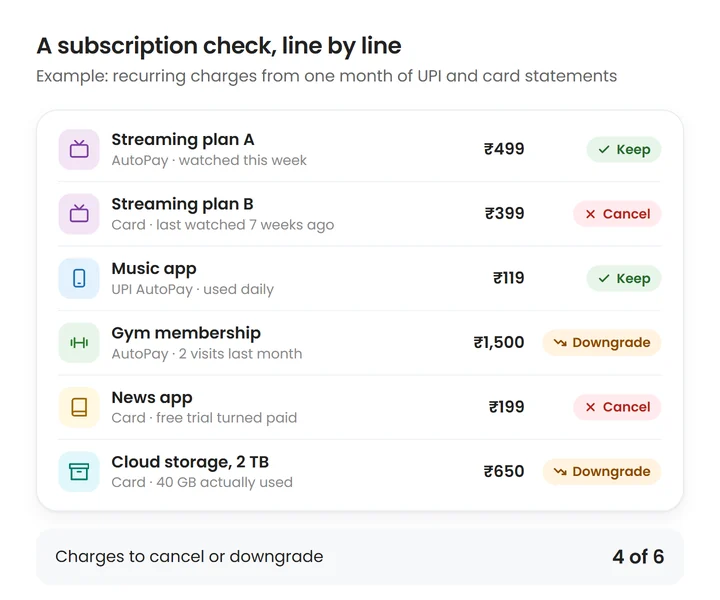
6. Audit subscriptions and AutoPay mandates
Open every UPI app you've ever used and look for active AutoPay mandates, then check your card statement for recurring charges. Anything you haven't used in the last month is a candidate to cancel. Our UPI AutoPay guide shows where each app keeps them.
7. Stop paying fees for nothing
Fees are pure loss. The usual suspects:
- Credit card interest and late fees. Pay the full statement balance, not the minimum due. A revolving card balance is one of the most expensive ways to borrow.
- Minimum balance charges on accounts you barely use. Close or consolidate them.
- Convenience and platform fees on tickets, bill payments and deliveries. Check whether paying directly avoids them.
- Failed payment charges, which usually come from an EMI or mandate hitting an account on the wrong day.
8. Put a ceiling on food delivery
Delivery is rarely one big expense; it's a dozen medium ones. Twelve orders at ₹450 is ₹5,400 a month. You don't have to stop. Pick a monthly ceiling, say ₹2,700 or about six orders, and treat anything beyond it as a conscious choice.
Two things help: keep a couple of 15-minute meals you actually like stocked at home, and turn off promotional notifications from delivery apps.
9. Watch the small UPI payments
Scanning a QR code for ₹60 doesn't feel like spending. That's the problem. A ₹150-a-day habit of tea, snacks and auto fares is ₹4,500 a month and ₹54,000 a year. Daily expense tracking explains why small purchases do so much damage, and managing UPI and card spending covers practical limits.
10. Right-size recharges, broadband and OTT plans
Plans creep upward and rarely get reviewed. Before renewing, check how much data you actually use, whether an annual plan works out cheaper than twelve monthly ones, and whether you're paying for two streaming services you watch in alternate months. There are more ideas in reducing monthly expenses without changing your lifestyle.
Spend smarter without feeling deprived
Once the leaks are fixed, saving more is about how you make everyday decisions, not about banning the things you enjoy.
11. Use a 48-hour rule for non-essential purchases
For anything non-essential above a threshold you choose (₹2,000 works for many people), add it to the cart and wait 48 hours. If you still want it after two days, buy it without guilt. Plenty of must-haves don't survive the wait, especially the ones prompted by a sale countdown.
12. Plan the grocery week and buy staples monthly
Quick-commerce apps are brilliant in an emergency and expensive as a habit, because a "just milk" order tends to arrive with three things you didn't plan. Buy staples like atta, rice, dal and oil once a month, plan the week's vegetables, and keep top-up orders for genuine gaps.
13. Collect what friends owe you, quickly
Money you fronted for a trip, a dinner or the flat's electricity bill is money you can't save until it comes back, and the longer it waits the more awkward it becomes to ask. Settle shared expenses within the week. Our guide to splitting expenses with friends shows how to do it without awkward calculations.
14. Save half of every raise and windfall
When your salary goes up, spending tends to rise to meet it within a couple of months. Decide in advance that half of any increment, bonus or tax refund goes to savings and the other half is yours to enjoy. You still feel the raise, and your savings rate climbs without a single painful cut. It's one of the money habits that help you save more every month.
15. Review your month for ten minutes every week
Pick a fixed slot, Sunday evening works well, and look at three things: what you spent this week, how much of the month's number is left, and one thing that surprised you. Weekly reviews catch drift while there's still time to correct it.
Where the money comes from: an example
None of these steps is dramatic on its own. Together, they add up. Here's how a salaried person spending about ₹38,000 a month might find ₹5,000 without changing where they live or what they do at the weekend.
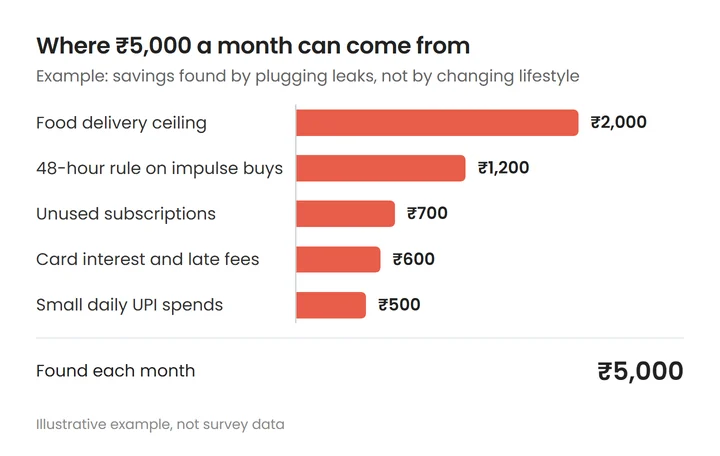
Your breakdown will look different, which is exactly why tracking a month comes first. For some people the biggest line is delivery; for others it's a gym membership used twice, or a card balance that has been revolving since Diwali.
A 30-day plan to start saving this month
Week 1: Track without changing anything
Record every payment, whether UPI, card or cash. The goal is an honest baseline, not a flattering one.
Week 2: Automate the transfer
Pick a separate savings account and schedule a transfer for salary day. Start small.
Week 3: Plug the leaks
Cancel unused subscriptions and mandates, stop avoidable fees, and set a ceiling for delivery and shopping.
Week 4: Set next month's number
Use what you learned to set a monthly spending limit, and put a ten-minute weekly review in your calendar.
The bottom line
Saving money every month is less about discipline than about order: save first, spend what's left, and make leaks visible. Do the one-time setup this week and let the habits carry the rest. If you're not sure where to begin, begin with tracking. Every other step works better once you know your real numbers.
Frequently asked questions
How much of my salary should I save every month?
A common starting point is 20% of take-home pay, but the right number depends on your rent, EMIs and dependents. If 20% isn't realistic yet, start with 5–10% moved automatically on salary day and raise it with every increment. Our guide on how much to save every month has worked examples by income.
How can I save money on a low salary?
Start smaller rather than not at all. On an ₹18,000–₹25,000 salary, even ₹1,000 moved out on salary day builds the habit and the beginnings of a buffer. Fix the leaks that cost nothing to fix first, such as unused subscriptions, late fees and delivery charges, and make sure shared costs like rent and groceries are split fairly with flatmates.
Should I keep my savings in a savings account or a recurring deposit?
They do different jobs. A savings account is flexible, which suits an emergency buffer. A recurring deposit commits you to a fixed monthly amount for a set period, which suits a goal with a date. Many people use both. Check current rates and premature withdrawal terms with your bank; this isn't a recommendation of any product.
What should I do in a month when I can't save anything?
Keep the habit even when the amount is zero: track the month anyway, so you know why it happened. One expensive month, like a wedding or a medical bill, is normal. If it happens every month, the cause is structural (rent, EMIs or lifestyle creep), and the fix is a budget rather than more willpower.
How do I stop overspending on UPI?
Make the spending visible and add a little friction. Keep savings in an account with no UPI linked, check your week's UPI spending every Sunday, and use a tracker that records payments automatically. The guide to managing UPI and card spending goes into more detail.