How to Create a Monthly Budget That You Can Actually Follow
Most budgets fail in the second week because they're built for an imaginary month. This one starts from what you actually spend and plans for the things that always seem to come up.
In this article
Almost everyone has made a budget. Far fewer have followed one past the second week. Usually it breaks the same way: a friend's wedding, a bike service, a festival, or simply a Saturday that cost more than the plan assumed.
That isn't a discipline failure. It's a planning failure. A budget that works is built from what your months actually look like, including the expenses that don't happen every month, and it has a way of recovering when things go off-plan.
- Start from last month's real spending.
- Use your take-home pay.
- Set savings first.
- List fixed costs.
- Turn irregular costs into monthly sinking funds.
- Set limits for everyday spending.
- Add a buffer.
- Check in weekly, adjust monthly.
Why most budgets fail by the 15th
- They're aspirational. "₹2,000 on eating out" when you've spent ₹5,000 every month this year.
- They forget irregular costs. Insurance, festivals and repairs arrive like emergencies even though they're predictable.
- They have no slack. One unplanned ₹1,500 and the whole plan feels ruined.
- Nobody looks at them. A budget checked on the 30th is a report, not a plan.
Each step below fixes one of these.
How to make a monthly budget, step by step
Step 1: Start from last month's real spending
Before deciding what you should spend, find out what you did spend. Go through last month's bank statement, UPI history and card statement, or better, the last three months, and total each category. If you haven't done this before, where is my money going? walks through it in about half an hour.
Step 2: Write down your take-home pay
Use the salary actually credited, not your CTC. If income varies, as it does for freelancers or people with incentives, budget on a cautious figure such as your lowest month in the last six, and treat anything above it as a bonus to allocate when it arrives.
Step 3: Set savings first
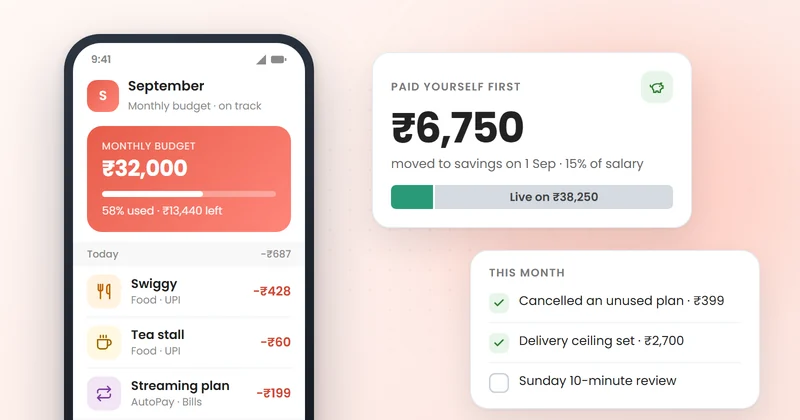
Decide your savings amount and treat it like a bill paid on salary day. A common target is 20% of take-home; if that's not possible yet, start lower and increase it. How much should you save every month? has examples by income.
Step 4: List your fixed costs
Fixed costs are roughly the same every month: rent, EMIs, insurance (as a monthly share), electricity, internet and phone, commute, school fees, household help. These are the easiest lines to plan and the hardest to change quickly, so it's worth knowing their total.
Step 5: Turn irregular costs into sinking funds
A sinking fund is money you set aside each month for a cost you know is coming. Divide the amount by the number of months until it's due. This is the step that stops "surprise" expenses from wrecking the month they land in.
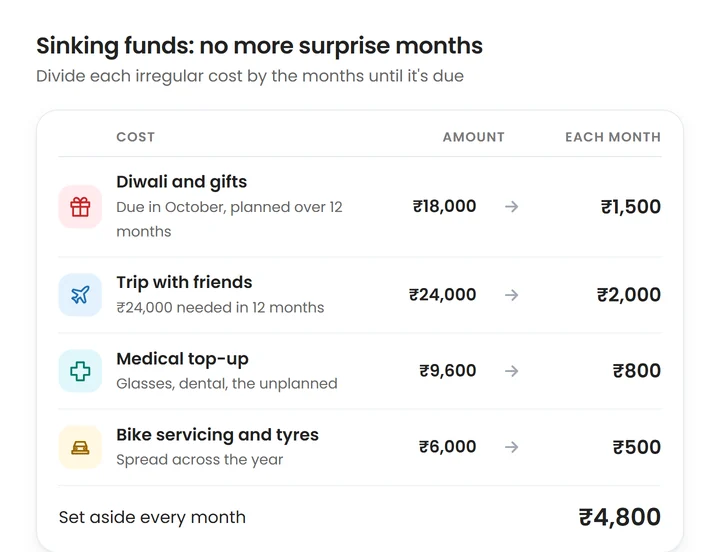
Common candidates in Indian households: Diwali and other festivals, weddings and gifts, annual insurance premiums, school admission and books, vehicle servicing and insurance, travel home, and gadget replacement.
Step 6: Set limits for everyday spending
Groceries, eating out, shopping, entertainment and personal care vary month to month. Take your average from step 1 and set each limit slightly below it, around 10% less, rather than an aspirational number. You can tighten further next month once the budget is holding.
Step 7: Add a buffer
Leave 3–5% of take-home unassigned for things you genuinely didn't foresee. The buffer is what lets a ₹1,500 surprise be a line item rather than a reason to give up on the budget.
Step 8: Check in weekly, adjust monthly
Once a week, compare spending so far with the plan. Once a month, adjust the limits based on what happened. Budgets improve with each month; the first one is always the least accurate.
A worked example: ₹60,000 take-home
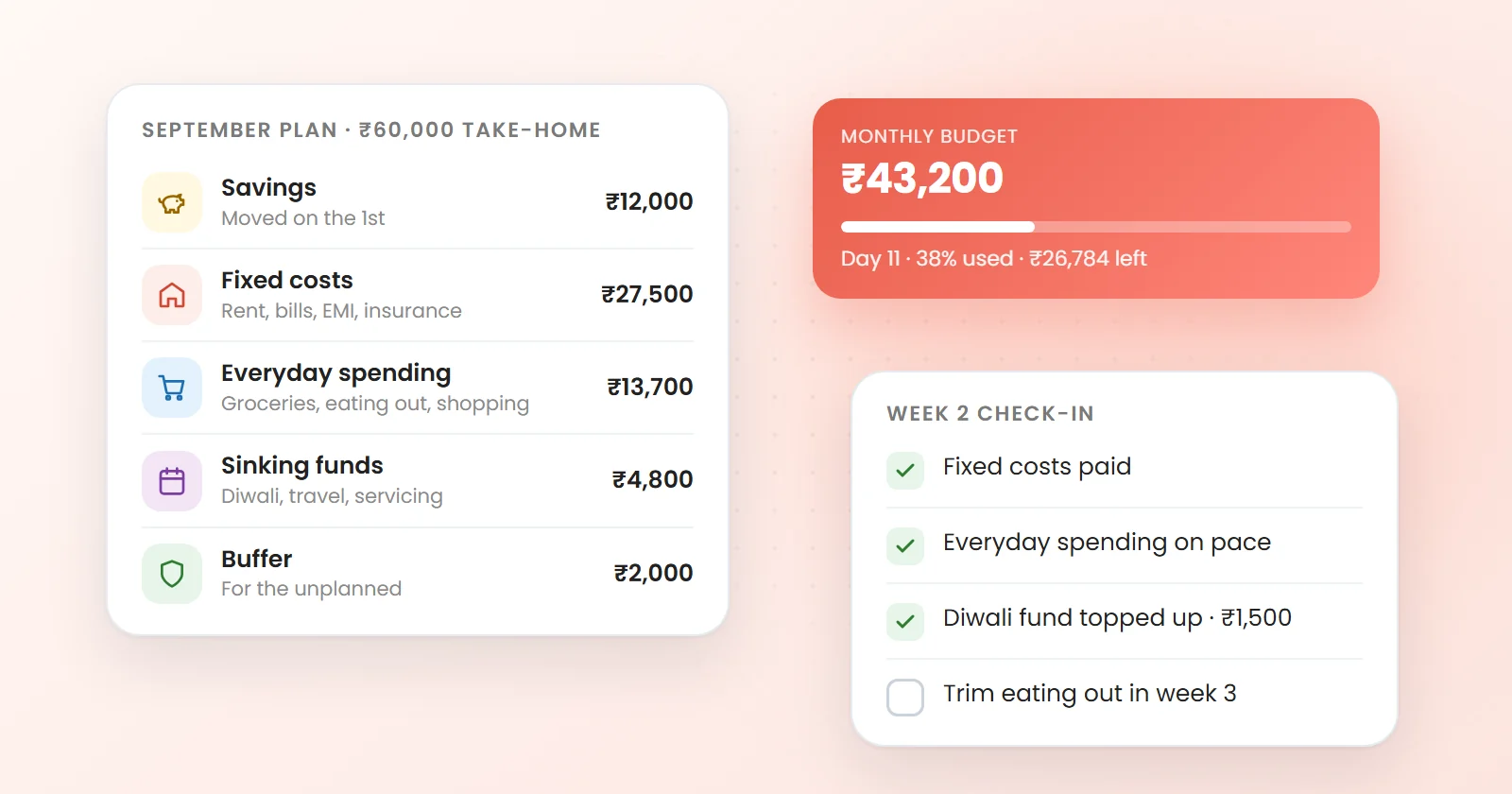
Here's how the steps come together for someone earning ₹60,000 a month, renting a one-bedroom flat, with a bike loan:
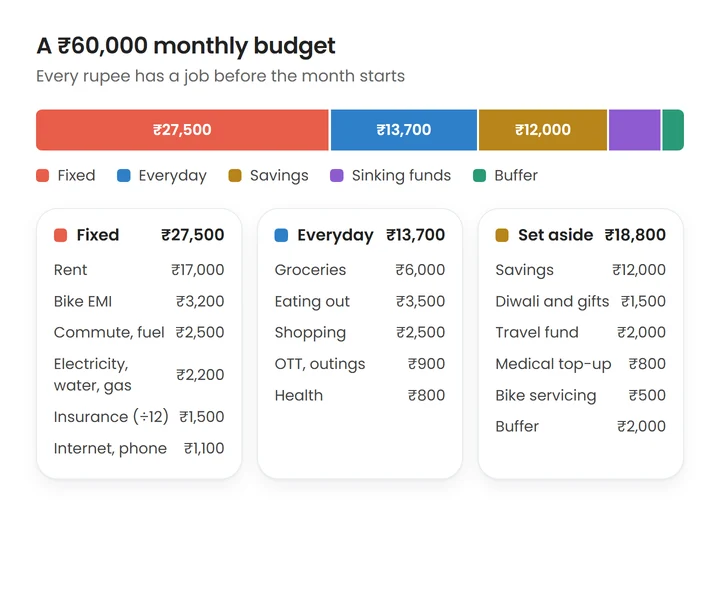
| Group | What's in it | Amount | Share |
|---|---|---|---|
| Savings | Moved to a separate account on the 1st | ₹12,000 | 20% |
| Fixed costs | Rent, bike EMI, commute, utilities, insurance, phone and internet | ₹27,500 | 46% |
| Everyday spending | Groceries, eating out, shopping, entertainment, health | ₹13,700 | 23% |
| Sinking funds | Diwali and gifts, travel, medical, bike servicing | ₹4,800 | 8% |
| Buffer | Unassigned, for the unexpected | ₹2,000 | 3% |
| Total | ₹60,000 | 100% |
The number to watch day to day is the spending part: fixed costs, everyday spending and the buffer, ₹43,200. Savings and sinking funds leave on salary day, so they're protected by default.
How to actually stick to it
Make it automatic
- Move savings and sinking funds out on salary day
- Pay fixed bills from one account
- Record spending automatically, not from memory
Make it forgiving
- Keep a buffer for surprises
- Move money between categories instead of abandoning the plan
- Include money for fun, so the budget is worth keeping
When a category overspends, don't declare the month lost. Cover it from the buffer or another everyday category, note why, and adjust next month's number if it keeps happening. A budget is a set of decisions you keep revising, not a test you pass or fail.
Small purchases are the usual reason everyday categories drift. Daily expense tracking explains how to keep them visible with a simple daily limit.
Budgeting with a partner or flatmates
If you share a home, decide which costs are shared and budget your share, not the whole bill. Couples have several fair ways to divide expenses, from 50:50 to proportional to income; see how to manage money as a couple. For flats, get rent and utilities split agreed first with how to split bills with roommates.
The bottom line
A budget you can follow is realistic, complete and forgiving: built from real numbers, including the costs that don't come every month, with a buffer and a weekly check-in. Pay savings and sinking funds first, give yourself one spending number to watch, and expect the plan to get better every month you use it.
Frequently asked questions
What should a monthly budget include?
Your take-home pay, savings, fixed costs such as rent and EMIs, everyday spending such as groceries and eating out, monthly amounts for irregular costs (sinking funds), and a small buffer. Every rupee of income should have a place.
How do I budget if my income changes every month?
Budget on a cautious income figure, such as your lowest month in the last six. In better months, allocate the extra deliberately: top up your buffer or emergency fund first, then savings goals.
What if I go over budget in one category?
Cover it from your buffer or another flexible category rather than abandoning the budget. If the same category overspends every month, the limit is unrealistic; raise it and lower something else.
Is the 50/30/20 rule a monthly budget?
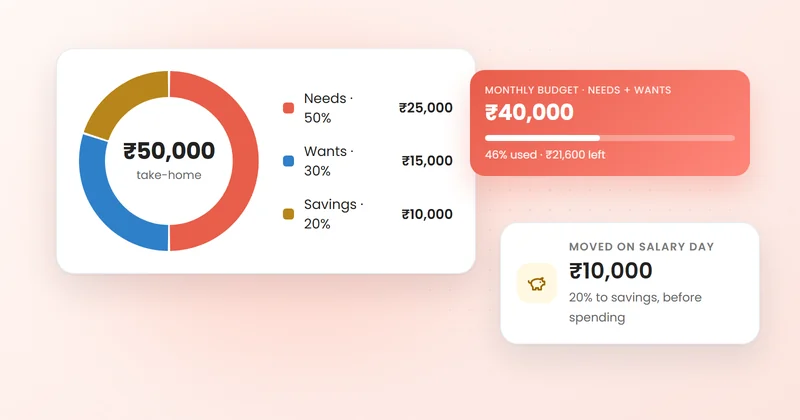
It's a simplified one. The 50/30/20 rule sets three broad proportions, which is a good start. A category budget like the one above gives more control over where overspending happens.
How much should I keep as a buffer in my budget?
Around 3–5% of take-home pay suits most people. It isn't a replacement for an emergency fund; it's there to absorb small surprises within the month.